 English
 Italiano
Critical and Interdisciplinary Expansion of Culinary Techniques Based on Complex Plant Matrices and Composite Thermal Systems
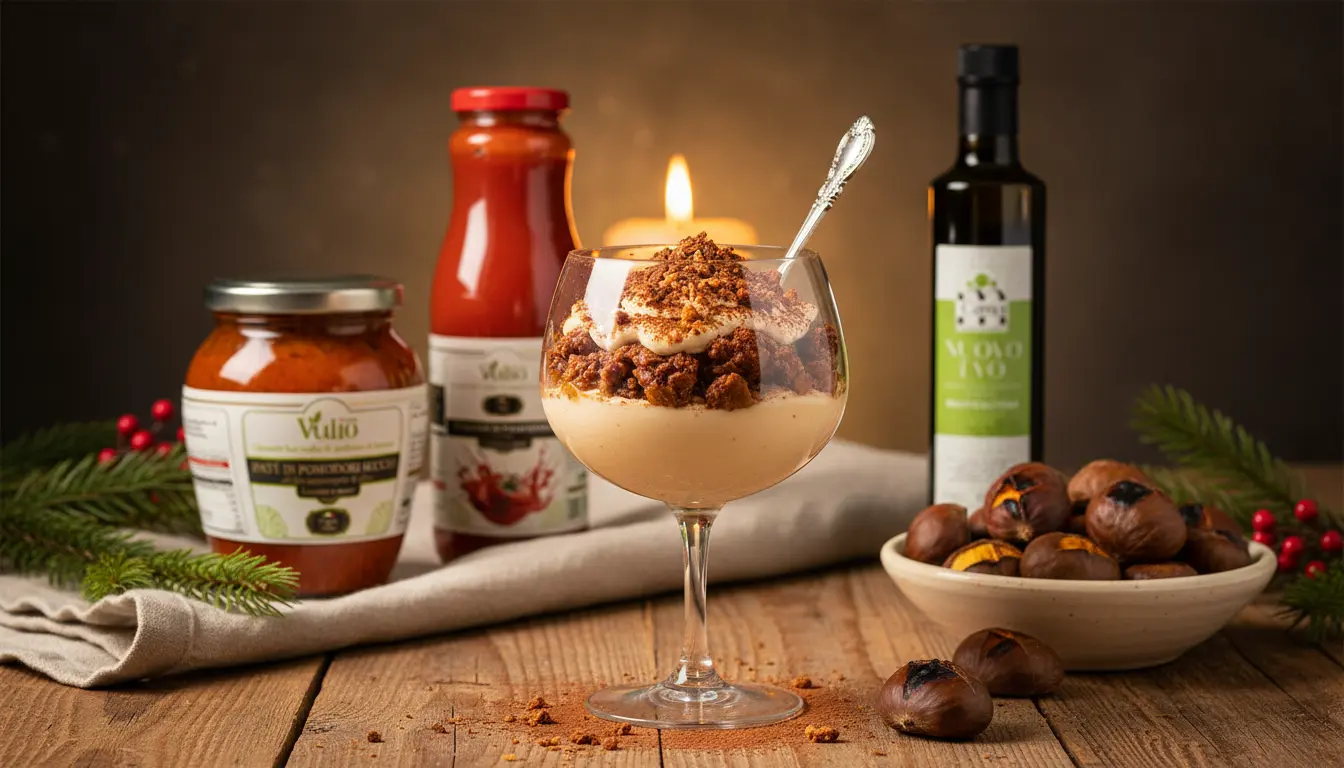
To introduce the reader more fluidly to the topic, it can be helpful to start with a concrete image: imagine, for example, a festive table set on Christmas Eve, where elements such as roasted chestnuts, artisanal preserves, and traditional preparations coexist in a rich and layered sensory balance. It is precisely in settings like this that the value of interactions between different food matrices emerges.
The technical-culinary analysis of chestnuts and plant-based preserves applied to Christmas preparations offers a particularly fertile framework for examining complex phenomena such as aromatic interactions, structural modifications of food matrices, release kinetics of volatile compounds, and transformations induced by thermal processes. Within the festive context, where the ritual dimension of food assumes an amplified symbolic function, these elements become even more relevant, as the perceptual, emotional, and cultural dimensions of food consumption intertwine with technical and technological aspects.
Chestnuts, presented in their various forms — Castagne del Prete, Organic and PGI Montella Fresh Chestnuts, and Shelled Dried Chestnuts — represent matrices rich in starches, simple sugars, and aromatic compounds that undergo significant transformations depending on drying, roasting, or cooking processes.
Similarly, preserves and pâtés such as Sun-Dried Tomato Pâté and Tomato Passata, together with oil-preserved vegetables, constitute complex systems in which the lipid phase, acidic compounds, pigments, and aromatic volatiles interact, giving rise to articulated flavor and aroma profiles.
The following expanded discussion provides an in-depth analysis of five Christmas preparations, broadening the theoretical framework through chemo-sensory observations, considerations on cooking dynamics, pairing hypotheses, and structural evaluations that allow for a richer and more multidimensional understanding of the behavior of food matrices.
Rustic Crostini with Sun-Dried Tomato Pâté and Crunchy Chestnuts
Technical Analysis of the Recipe
To ensure continuity and cohesion between one preparation and the next, this analysis serves as a natural extension of the technical-sensory pathway previously established, maintaining the logical thread that connects the various culinary principles examined.
In this preparation, the relationship between the lipid phase, aromatic compounds, and contrasting textures allows for the observation of several simultaneous phenomena. The pâté exhibits a high concentration of liposoluble compounds — particularly carotenoids and aromatic aldehydes — which, interacting with the porous structure of toasted bread, enable a more efficient diffusion of aromas. Castagne del Prete, thanks to the traditional roasting process, develop smoky notes attributable to secondary Maillard reaction compounds.
The presence of Licampi Multicultivar Extra Virgin Olive Oil, characterized by a significant polyphenolic profile, intensifies the balanced bitter perception, contributing to the modulation of the overall sensory amplitude.
Expanded Ingredients:
The selection of ingredients does not respond solely to gastronomic criteria, but also reflects the intention to observe specific chemo-sensory interactions. Each element in the list actively contributes to the construction of the preparation’s aromatic and textural profile, helping to define the balance between the lipid phase, the plant-based component, and the aromatic notes introduced by herbs and spices.
- Artisanal bread with medium hydration level
- Sun-Dried Tomato Pâté
- Coarsely chopped Castagne del Prete
- Licampi Multicultivar Extra Virgin Olive Oil
- Fresh rosemary rich in monoterpenes
- Optional addition of dried chili flakes
Preparation
- Toasting generates volatile aromatic compounds through Maillard reactions and sugar caramelization.
- The paté acts as an aromatic carrier thanks to its lipid matrix, which enhances the solubility and perception of volatile compounds.
- Castagne del Prete introduce a multiphasic textural dimension: surface crispness combined with an inner floury body.
- Rosemary contributes balsamic freshness due to its dominant terpenes (α-pinene and cineole).
- The addition of chili pepper, if present, introduces trigeminal stimulation.
Christmas Pasta with Tomato Passata and Dried Chestnuts
Technical Analysis of the Recipe
This preparation makes it possible to examine phenomena such as starch gelatinization, water reabsorption in dried chestnuts, and interactions between the acidic phase of the tomato passata and the starchy structure. The rehydration of the chestnuts, in fact, generates a complex textural profile that varies according to soaking time and temperature.
Analytical Ingredients:
- Short pasta with high surface area (penne, rigatoni)
- Tomato Passata with high lycopene content
- Shelled dried chestnuts
- Licampi Multicultivar Extra Virgin Olive Oil
- White onion
- Whole sea salt, freshly ground black pepper
Preparation
- During rehydration, a partial reconstruction of the chestnuts’ cellular structure can be observed.
- The onion soffritto introduces sulfur compounds that contribute to the aromatic roundness of the dish.
- La passata, sottoposta a cottura moderata, sviluppa densità e complessità attraverso l’evaporazione dell’acqua.
- The incorporation of chestnuts creates a sweet-acid contrast and a perceptible textural progression.
- The final emulsification with multicultivar extra virgin olive oil increases perceived viscosity and enhances aromatic persistence.
Grilled Zucchini Rolls Preserved in Oil with Ricotta Cream and Chestnuts
Technical Analysis of the Recipe
The rolls represent an effective example of a preparation in which the lipid component influences aromatic extraction and diffusion. The grilled zucchini preserved in oil display an aromatic profile enriched by compounds generated during grilling, including furans, aldehydes, and smoky compounds.
Detailed Ingredients:
- Grilled Zucchini Preserved in Oil
- Low-moisture ricotta
- Finely crumbled Castagne del Prete
- Black pepper
- Optional aromatic herbs (lemon thyme, marjoram)
Preparation
- The zucchini preserved in oil exhibit an intermediate texture between succulence and firmness.
- Ricotta introduces a creamy phase that acts as a sensory buffer between intense aromatic components.
- Chestnuts contribute sweetness and a granular texture.
- Black pepper acts on the trigeminal dimension, enhancing gustatory depth.
- The addition of herbs may introduce citrus or balsamic notes.
Christmas Stew with Sun-Dried Tomatoes Preserved in Oil and Fresh Chestnuts
To broaden the analytical perspective and deepen the interpretative understanding of this preparation, it is useful to briefly compare this technique with alternative cooking methods, such as sous-vide cooking or the use of a pressure cooker, both of which significantly modify the dynamics of protein denaturation and aromatic release.
Technical Analysis of the Recipe
The stew allows for an in-depth observation of protein transformation phenomena typical of slow cooking methods. The denaturation of myofibrillar proteins, combined with the progressive solubilization of collagen, leads to the formation of a gelatinous structure that imparts tenderness to the meat.
The incorporation of sun-dried tomatoes preserved in oil introduces umami compounds (natural glutamate) and carotenoid pigments that influence both color and aromatic persistence.
Fresh chestnuts function as a complementary starchy phase, contributing to gustatory roundness and structural complexity.
Expanded Ingredients:
- Meat suitable for long cooking (chuck roast, shank)
- Sun-dried tomatoes preserved in oil
- Organic and PGI Montella Fresh Chestnuts
- https://vulio.eu/product White onion
- Dry white wine
- Licampi Multicultivar Extra Virgin Olive Oil
- Optional spices (bay leaf, juniper berries, black pepper)
Preparation with In-Depth Analysis of Transformations
- The initial searing of the meat generates aromatic compounds through Maillard reactions, which are fundamental for building the dish’s flavor profile.
- Deglazing with white wine promotes the volatilization of alcohols and the deposition of acids, contributing to aromatic balance.
- The addition of sun-dried tomatoes introduces phenolic compounds and organic acids that modulate the sweet-salty equilibrium.
- Fresh chestnuts, added during the intermediate stage, gradually soften and integrate into the resulting gelatinous matrix.
- The selected spices complete the aromatic framework through resinous, balsamic, or slightly pungent notes.
Spoon Dessert with Dried Chestnuts and Soft Cream
Technical Analysis of the Recipe
The dessert makes it possible to observe the transition of dried chestnuts from a fibrous matrix to a creamy structure through hydration and cooking processes in a dairy-based environment. The combination of simple sugars, milk fats, and chocolate aromas generates a multiplicity of sensory interactions that make the dish particularly interesting from a technical standpoint.
Ingredients:
- Shelled dried chestnuts
- Whole milk
- Sugar
- Whipped cream
- Dark chocolate
Preparation with Structural Observations
- Cooking the chestnuts in milk produces a modification of their cellular structure, making them suitable for blending.
- Blending creates a stable emulsion, with uniform dispersion of starch within the liquid phase.
- The alternation between cream and whipped cream generates density contrasts that enhance tactile complexity.
- Chocolate shavings introduce bitter and aromatic notes that enrich the overall sensory profile.
Conclusions
These five Christmas preparations — analyzed from an advanced perspective integrating sensory, molecular, and technological aspects — offer a concrete demonstration of how different food matrices can interact harmoniously, generating dishes that are complex both aromatically and structurally.
Chestnuts, in their various forms of transformation, represent an extremely versatile ingredient, capable of interacting with vegetable preserves, pâtés, and lipid systems in sophisticated culinary applications. At the same time, Vulìo preserves and oil-based preparations provide an aromatic and technological heritage that is ideal for advanced studies and experimentation.
The recipes presented can therefore be considered not only as ideas for a Christmas menu, but also as case studies useful for exploring cooking processes, molecular transformations, sensory analysis, and food pairing principles. From a future-oriented perspective, these techniques could be applied to the study of new gastronomic combinations, the development of innovative products based on complex plant matrices, or the predictive analysis of sensory behavior through advanced models. In this sense, the work presented here offers a solid foundation for further research and high-level culinary experimentation.